The short answer
A ZLP (zero line pressure) conveyor is a powered roller conveyor split into short zones, each with its own 24V motorised roller and sensor. When products queue up, each one stops in its own zone with a gap in front, so nothing gets pushed, squashed or knocked over.
If you’ve ever watched boxes back up on a conveyor, you’ll have seen the problem: the ones at the front get pushed by everything behind them. Labels scuff, cartons crush and totes jam. A zero line pressure conveyor fixes that. This guide explains how a ZLP conveyor works in plain English, where it makes sense and what to think about before you buy one.
What does “zero line pressure” mean?
“Line pressure” is the push that builds up when products queue on a conveyor. Think of a queue at a shop where everyone at the back keeps shuffling forward. The person at the front gets squashed against the till.
On an ordinary conveyor, the rollers keep turning or gravity keeps pulling, so each box presses on the one in front. The longer the queue, the bigger the push.
Zero line pressure means that push is taken away completely. Each product waits in its own space, like people standing on marked spots, and only moves up when the spot in front is clear.

How does a ZLP conveyor work?
A ZLP conveyor is built from zones. On our conveyors a zone is usually 750mm long, so a 3m section has four zones. Every zone has three parts:
- A motorised roller. This is a 24V roller with a small motor inside it. It drives the other rollers in its zone using round drive bands or Poly-V belts.
- A sensor. This is a photoelectric eye that sees whether a product is sitting in the zone.
- A zone control card. This is the small “brain” that tells the motorised roller when to run and when to stop.

The rule each zone follows is simple:
- If there’s a product in my zone and the zone in front is full, I stop and wait.
- When the zone in front empties, I start and pass my product forward.
- If my zone is empty, I switch off and save power.
That’s it. Because each zone only moves when there’s space ahead, products never touch while they queue. When the line starts moving again, they move off one after another with the gaps still in place.

Single-zone cards or 4-zone cards?
Short runs usually use a single-zone card for each zone. Longer conveyors use 4-zone cards, where one card looks after four zones. This means less wiring and fewer parts. On bigger systems a PLC (a small industrial computer) and a touchscreen sit over the top, so operators can start and stop lines, jog zones and see faults.
Release one at a time, or all together
Most ZLP conveyors can release products in two ways:
- One at a time (singulation). Products leave the queue with a gap between each one. This is ideal for feeding a scanner, X-ray machine, labeller or packing station.
- All together (slug release). The whole queue moves off at once to clear the line quickly.

ZLP compared with other roller conveyors
| Conveyor type | What happens when products queue | Good for |
|---|---|---|
| Gravity roller | Products roll down and press against each other. Pressure builds the longer the queue. | Simple, low-cost runs with no power |
| Line shaft or chain driven | Rollers keep turning under stopped products, so they still push forward and rub. | Steady transport, heavier loads |
| ZLP (zero line pressure) | Each zone stops on its own. Products wait with a gap and never touch. | Buffering, accumulation, feeding machines, fragile or stackable products |
What are the benefits of a ZLP conveyor?
- No damage. Products don’t crush, scuff or topple, because they never press on each other.
- Quiet. There are no long chains or line shafts. Each zone has a small motor, and the rollers only turn when they need to.
- Lower running costs. Empty zones switch off, so you’re not powering a whole line to move one box.
- Safer to work around. It runs on low-voltage 24V drives, with no exposed chains or big gearboxes.
- Easy to change. It’s built from sections, so you can add zones, curves, merges and transfers later as the operation grows.
- Smooth flow. Products are released in a controlled way, which keeps scanners, labellers and packing benches fed at the right rate.
What can a ZLP conveyor carry?
ZLP conveyors work best with products that have a flat, firm base long enough to sit across several rollers:
- Cardboard boxes and cartons
- Plastic totes and crates
- Parcels, and mail bags in trays
Our ZLP conveyors are built for indoor warehouse, factory and distribution use. They aren’t designed for outdoor use or open food handling.

What to think about before you buy a ZLP conveyor
- Your products. What’s the smallest and largest item, and the heaviest? This sets the roller pitch, the zone length and whether 24V is enough. 48V drives are used for heavier items.
- Width. Our standard roller widths are 450mm, 600mm, 750mm and 1000mm between frames.
- Roller pitch. This is the gap between rollers: 60mm, 75mm, 100mm or 150mm. Smaller products need a closer pitch.
- Layout. Plan for straights, curves, merges, diverters and transfers, and for where people need to walk through.
- Controls. Decide whether you need stand-alone zones, or a PLC and touchscreen linked to other machines such as scanners, X-ray units or a WMS.
- Throughput. Work out how many items per hour need to move, and where the queues will build up.
Send us a sketch, product sizes and weights, and we can design the right system around them.
ZLP conveyors in action
- Evri at Heathrow: a ZLP conveyor buffer loop with powered curves and merges, feeding parcel X-ray sorting.
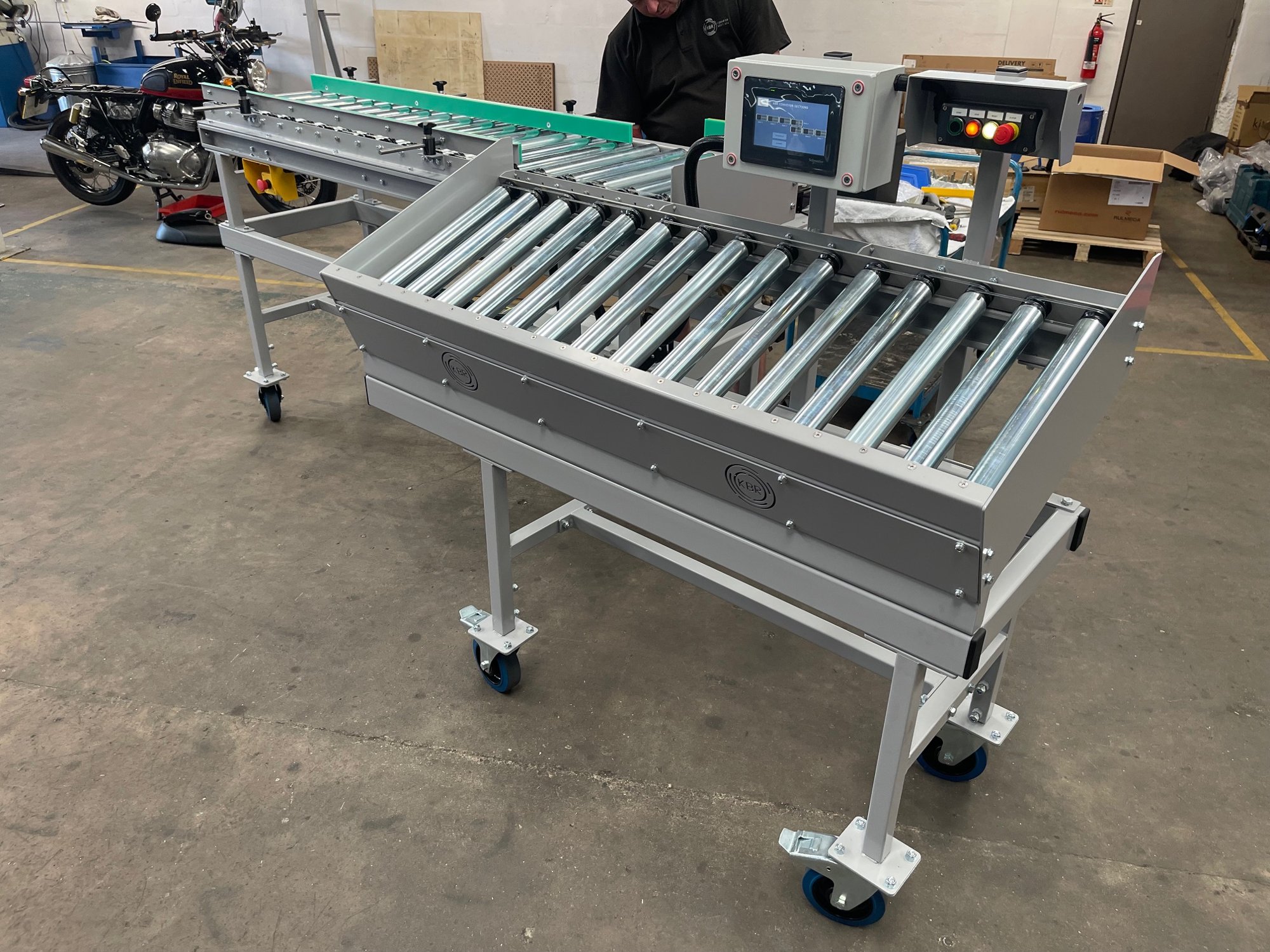
- Cosmetics manufacturer: a mobile ZLP transfer conveyor with an electric transfer paddle and touchscreen controls.
ZLP conveyor FAQs
Is a ZLP conveyor the same as a ZPA conveyor?
Yes. ZPA stands for zero pressure accumulation. It’s another name for the same thing. Some suppliers, especially in the US, say ZPA, while in the UK it’s usually called ZLP.
Is 24V safe?
24V is classed as extra-low voltage. It’s much safer to work around than mains-powered drives. The control panel is still fed from a normal mains supply and includes emergency stops.
Can I add zones later?
Yes. ZLP conveyors are modular, so extra sections, curves and merges can be added as long as the controls and power supplies are sized for them.
Do ZLP conveyors use a lot of power?
No. Each zone only runs when it has something to move, so a ZLP conveyor usually uses less energy than a line that runs all the time.
Thinking about a ZLP conveyor?
See specs, options and photos on our ZLP conveyor page, or send us your layout for a quote.